

Using Public Data to Spot Transit Infrastructure Projects Before They Hit the Bid Phase
Transit projects often look sudden only because most market participants begin paying attention too late. Long before a solicitation appears, the outlines of many investments are already visible in public documents: board materials, long-range plans, capital budgets, environmental studies, grant narratives, and operating performance reports. By the time a project reaches procurement, much of its logic has already been disclosed in plain sight.
That represents a direct revenue opportunity for AEC and consulting firms — one that most leave on the table by engaging the market only after a bid notice appears. Transit AI tracks capital plans, procurement activity, and award histories across US transit infrastructure to help firms identify where real opportunity is emerging. Its consistent finding: the pre-bid window is where the most strategically valuable intelligence lives, and most firms are not using it well enough.
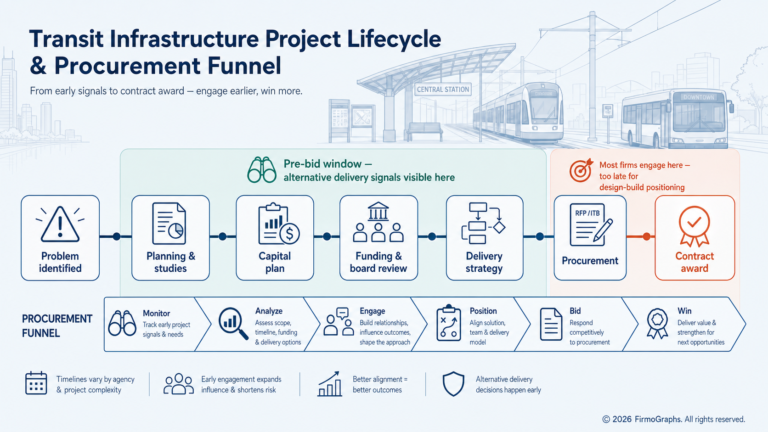
The pre-bid phase is longer than it appears
Transit infrastructure follows a recognisable institutional path. A problem appears first: unreliable service, constrained capacity, deteriorating assets, accessibility gaps, safety concerns, or pressure to decarbonise fleets and facilities. That problem is then translated into studies, planning documents, funding discussions, and eventually a capital programme. Procurement comes late in that sequence — sometimes years after the underlying need was first documented publicly.
Each stage leaves evidence. A corridor study foreshadows future bus-priority work. A fleet transition plan points to charging infrastructure and depot upgrades. A board presentation on asset condition signals an approaching rehabilitation programme. None of these items is a tender notice, but each narrows the range of what is likely to come next. Taken in sequence, they constitute a time-lapse record of institutional intent — one that rewards firms disciplined enough to read it systematically rather than reactively.
The practical implication is that AEC and consulting firms have a longer runway than most realise. A project that appears in a five-year capital plan today may not reach procurement for two or three years — but the firms best positioned to win it are already engaged. They are not waiting for the RFP; they are shaping the conversation that precedes it. That matters most when an agency is moving toward alternative delivery. If a project is likely to remain a traditional design-bid-build procurement, early visibility is still useful, but its commercial value is narrower. For firms pursuing transit work, the real advantage comes when early signals indicate the potential for design-build, progressive design-build, CM/GC, or another delivery structure in which pre-procurement positioning, team formation, and owner engagement matter materially more.
Capital plans are the clearest public signal
Among public records, capital improvement plans are especially valuable because they translate intent into allocation. Strategy documents can remain broad; capital plans typically assign years, values, and categories to projects. That makes them useful for identifying when a rail, bus, station, facility, power, or digital systems investment is becoming operationally real rather than aspirationally stated.
The real insight comes from comparing successive plans. A single capital plan describes what an agency says it intends to do. Year-on-year comparison shows momentum: which projects are new, which are expanding, which are slipping, and which are being quietly dropped. Those movements reveal far more than any static snapshot — they expose shifts in fiscal confidence, political backing, technical complexity, and delivery readiness. They can also hint at whether an agency is assembling the conditions for alternative delivery: larger project bundling, schedule urgency, complex interfaces, or repeated references to industry engagement and delivery innovation. For AEC and consulting firms, that signal is the difference between entering a pursuit early with strategic context and arriving late with a generic proposal.
Useful signals exist outside the budget book
Capital plans do not stand alone. Open data portals and performance dashboards often reveal operational pressures that later become capital priorities. Chronic delays on a corridor, recurring equipment failures, persistent accessibility issues, or signs of crowding can all suggest where future investment is likely to concentrate. Operational stress is frequently the first draft of capital demand.
Policy documents provide another layer of foresight. Climate goals, equity frameworks, land-use strategies, and safety initiatives influence which kinds of projects agencies can justify and fund. Grant applications are particularly revealing: they require agencies to narrate need, expected impact, and readiness in public filings that often disclose project maturity well before local capital documents fully reflect it. Firms that read these signals can position themselves as informed partners — not just responsive bidders.
Award histories matter too. Which firms have won work from a given agency, in which project categories, and under which delivery models tells a story about incumbent relationships, competitive intensity, and the kinds of teams an agency tends to favour. That context is rarely available in a single document, but it is consistently present in the public record for those willing to aggregate it.
Why alternative delivery changes the value of early intelligence
In practice, the commercial value of knowing early depends less on whether a project exists than on how it is likely to be delivered. If a transit investment is expected to proceed through a traditional design-bid-build path, early awareness can still support planning, staffing, and light market monitoring. But in many cases it does not materially change the competitive outcome, because the scope is largely fixed, the field is broadly open, and price or fee competitiveness carries more weight once procurement begins.
Alternative delivery changes that equation. When a project is moving toward design-build, progressive design-build, CM/GC, or another integrated delivery structure, early intelligence becomes much more valuable. Team formation starts earlier, owner engagement matters more, technical positioning can shape credibility before the solicitation is released, and the quality of partner choice can materially affect whether a pursuit is even viable. In those cases, knowing six to twelve months earlier is not just informative — it can change who is in the room, how the opportunity is pursued, and whether the work is worth serious investment at all.
Why public data is still underused
The difficulty is not scarcity of information but fragmentation. Agencies, metropolitan planning organisations, state DOTs, and funding bodies publish data in different places, formats, and naming conventions. The same project can appear as a corridor improvement in one document, a capacity upgrade in another, and a programme line item in a third. Public data is abundant, but it is rarely organised for comparison.
That is why many teams still default to tracking bids alone. It is simpler administratively, even if it is weaker strategically. By the time a formal procurement is issued, the market is already crowded, pursuit costs are rising, and the deeper context of the project has often been publicly available for years. Arriving at that point and calling it early intelligence is closer to late recognition — and the win rates tend to reflect it.
Just as importantly, not every early signal deserves the same level of attention. For many firms in transit, the highest-value question is not simply whether a project is coming, but whether its likely delivery model makes early positioning worthwhile. A conventional design-bid-build package may still matter, but it rarely justifies the same level of pursuit investment as a likely alternative-delivery opportunity where team structure, owner familiarity, and strategic timing can materially affect the outcome.
Where AI adds practical value
AI changes the economics of this work by reducing the cost of making fragmented public information usable at scale. It can extract project names, locations, asset types, and values from inconsistent documents; reconcile references to the same project across multiple sources; and organise changes over time into a cleaner view of the pipeline. Its value is not prediction — it is disciplined interpretation applied systematically across a volume of public records that no manual team can sustain.
The result is a different kind of market visibility. Rather than knowing that federal transit funding has increased by a given percentage, a firm can see which specific agencies are moving projects toward procurement, which corridors are gaining traction, and where competitive activity is beginning to cluster. More importantly, it can begin to distinguish between projects where early awareness has limited strategic value and projects where alternative delivery could make early intelligence commercially decisive.
Why this matters for AEC and consulting firms
For AEC and consulting firms pursuing transit work, the commercial case for early-stage intelligence is straightforward. Consider what firms typically spend — in time, travel, and senior attention — on pursuits that were never realistically winnable because a competitor had been engaged with the client for two years before the solicitation appeared. Better pre-bid intelligence does not just improve win rates; it reduces the cost of wasted pursuit and allows the same business development budget to be deployed more selectively.
Early visibility also changes the quality of engagement. Firms that arrive at a transit agency with knowledge of its capital sequence, its funding constraints, and its delivery history can shape scope, delivery model, and teaming strategy before those decisions are made by others. Specifically, early-stage market intelligence enables firms to:
- Prioritise pursuits where capital plan history and funding signals point to near-term procurement readiness.
- Identify emerging project families — such as depot electrification or station accessibility programmes — and build relevant expertise before competitors do.
- Make sharper go/no-go decisions based on project trajectory, not just notice of intent.
- Begin teaming and partner conversations early, before the most capable partners are already committed elsewhere.
- Identify projects where alternative delivery is becoming more likely, and focus scarce pursuit resources where early positioning can genuinely change the outcome.
- Reduce pursuit cost per win by concentrating resources on opportunities with the clearest path to award.
In a capital-intensive, relationship-driven market, that structural advantage compounds. Firms that build it tend to win more selectively and spend less doing it — a combination that is increasingly decisive as transit procurement grows more competitive and pursuit budgets come under greater scrutiny.
How Transit AI can help
Transit AI is built on a bottom-up approach to transit market intelligence — turning a scattered trail of board packets, planning studies, and capital documents into a structured, searchable view of where real procurement opportunity is emerging and how it is moving. Rather than asking business development teams to manually track hundreds of capital plans, grant applications, and procurement notices across dozens of agencies, Transit AI organises those signals into a consistent, comparable format that supports earlier and more informed pursuit decisions.
For AEC and consulting firms, this means replacing generic market-size slides with a living map of specific transit projects, their funding status, and their likely delivery timelines. More importantly, it means distinguishing between projects where early intelligence has limited strategic value and projects where it can materially influence pursuit outcomes. That distinction often turns on delivery model. If a project is likely to proceed through a conventional design-bid-build path, early awareness may help with planning but may not justify heavy pursuit investment. If the signals point toward alternative delivery, however, early intelligence becomes much more valuable because partner strategy, technical positioning, and owner familiarity can all begin to compound before formal procurement starts.
The economic argument is direct: the cost of assembling public infrastructure intelligence should not exceed the value of acting on it early. Transit AI is built to close that gap — giving firms the timing, targeting, and context to compete more efficiently in a market where the most consequential decisions are made long before the first RFP is issued.
Helping AEC and consulting firms pursue the right transit projects, at the right time, with eyes open. Learn more at Transit AI.